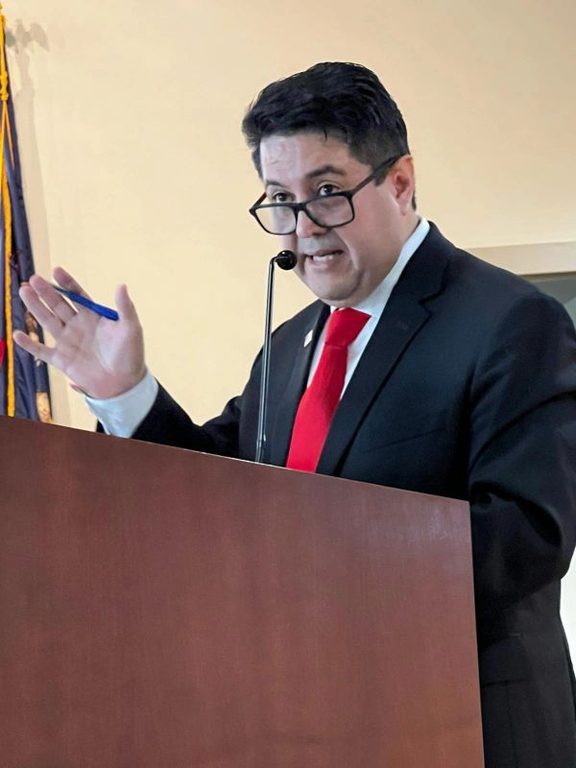
Rep. Haley Stevens wants U.S. Customs and Border Protection to clear a system backlog she says is costing local small businesses tariff refunds.
Stevens and Rep. Steven Horsford of Nevada sent a letter to CBP Commissioner Rodney Scott on Wednesday, Sept. 9, calling for immediate fixes to the agency's Consolidated Administration and Processing of Entries system, known as CAPE. The portal is the only way importers can file for refunds on tariffs the Supreme Court struck down in February. Businesses have reported delays that threaten their ability to meet a rolling 90-day filing window.
"Michigan businesses should not have to pay the price once let alone twice, first through illegal tariffs, and again because government red tape prevents them from getting their money back," Stevens said in a statement. "Small businesses in Michigan operate on tight margins, and every dollar matters."
Stevens represents Michigan's 11th Congressional District, which includes Birmingham, Bloomfield Hills and Bloomfield Township.
What happened
The Supreme Court ruled 6–3 on Feb. 20 in Learning Resources, Inc. v. Trump that the International Emergency Economic Powers Act (IEEPA) does not authorize the president to impose tariffs. All IEEPA tariffs ended Feb. 24. According to a CBP declaration filed with the U.S. Court of International Trade, the agency had collected roughly $166 billion in IEEPA duties across more than 53 million entries from over 330,000 importers.
CBP built the CAPE system to process refunds after the Court of International Trade ordered the agency to return the money. Phase 1 went live April 20 and covered most unliquidated entries.
As of June, CBP had certified more than $20 billion in refunds for disbursement, according to court filings cited by the law firm Morgan Lewis. Phase 2 launched June 29 to handle entries under CBP's Reconciliation Program. A planned Phase 3, not yet live, and which CBP says it isn't currently authorized to process, is intended to eventually cover fully liquidated entries.
The bottleneck
Refunds are not automatic. Importers must create an account in CBP's electronic system and file claims with accurate entry data. Trade attorneys have reported that businesses requesting new accounts as far back as February were still waiting months later, according to industry publication ASI Central. A process that normally takes one to two weeks has stretched into a multi-month delay.
The 90-day window is not a single deadline. Under federal law, CBP has 90 days to voluntarily reliquidate an entry after its liquidation date, but for CAPE Phase 1, the agency has set a tighter practical cutoff of 80 days, holding back the remaining 10 days as an administrative buffer. Once that window closes for a given entry, the standard refund path shuts with it.
In their letter, Stevens and Horsford wrote that companies should not suffer both from tariffs the Supreme Court struck down and from a broken refund system.
What's next
The Trump administration appealed the Court of International Trade's refund order on June 2, challenging its universal scope. That appeal remains pending. Stevens's letter does not set a response deadline for Scott, and CBP has not publicly responded to the lawmakers' demand.