Troy's fire department is responding to more lithium-ion battery fires inside occupied homes in 2026, a dangerous shift from smaller blazes in garbage trucks last year, Staff Lt. Keith R. Young told the Oakland County Times on Monday, July 20.
The change matters for Birmingham and Beverly Hills residents because both cities share recycling services through SOCRRA, the Southeastern Oakland County Resource Recovery Authority, which has urged residents not to place batteries in curbside bins after a string of garbage-truck fires in the region.
Why these fires can't be fought the usual way
A lithium-ion battery in thermal runaway does not need oxygen to keep burning. That makes the standard firefighting tactic of smothering or cutting off airflow useless.
"Normally if you take oxygen, fire or fuel away you wane the fire process," Young said. "But with lithium batteries and thermal runaway there is no way to disrupt the fire, making it very difficult for us to put these fires out."
Water can cool surrounding materials but won't stop the battery itself. Young said crews try to remove the burning cell from a building and let it burn outside safely when possible. Fire blankets used by hazmat teams can help contain flames, Young said, but may allow hazardous gas to build underneath.
No definitive firefighting solution exists yet.
The garbage truck pattern
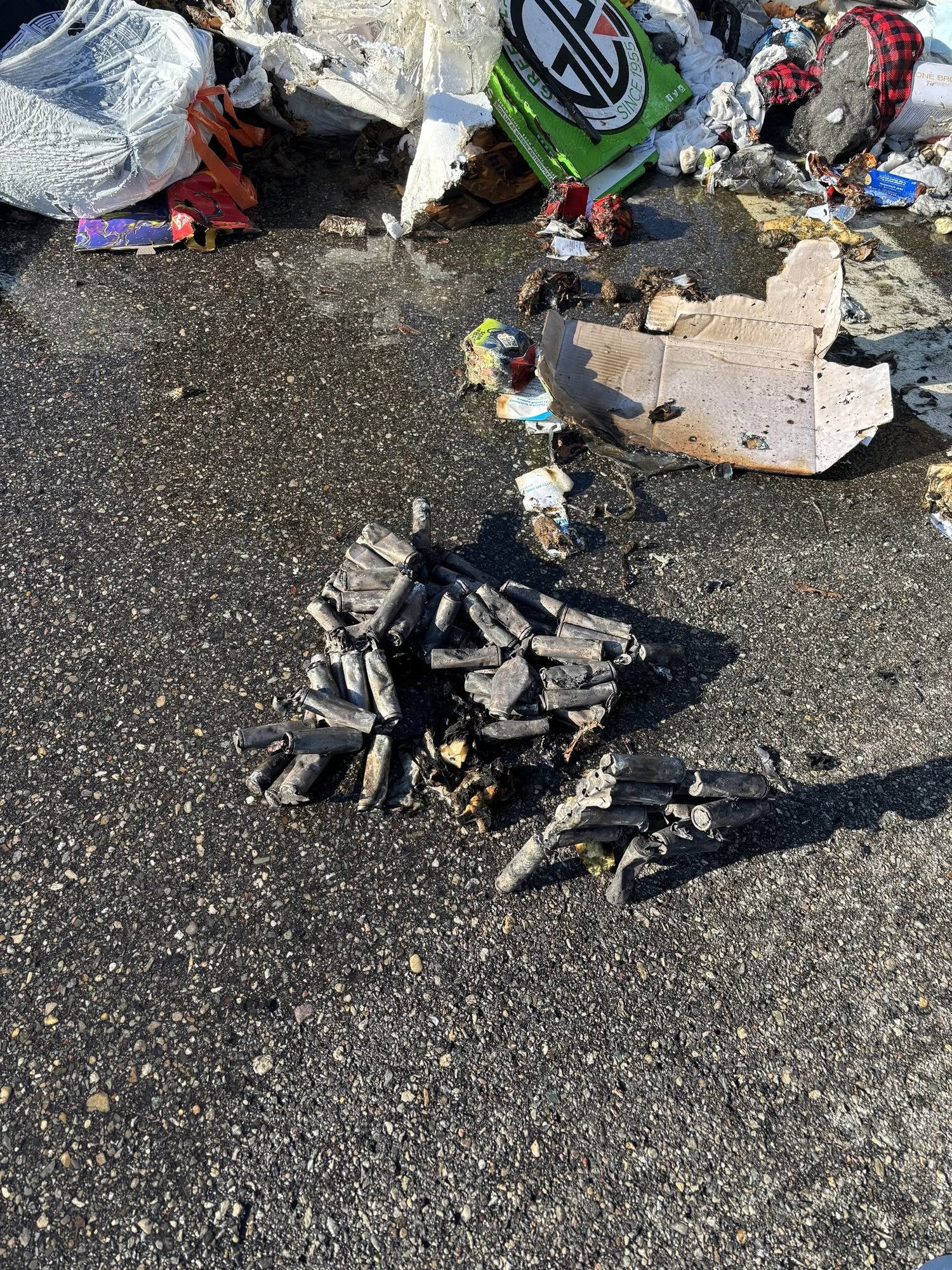
Troy responded to multiple lithium-ion battery fires in 2025, most caused by batteries improperly thrown in the trash and then crushed inside collection trucks. When a truck's rear catches fire, the driver dumps the load onto the street. Young said loose, burning trash blown by wind can then ignite nearby objects.
The Bloomfield Township Fire Department flagged the same pattern in a July 2025 public advisory, noting fires were starting as soon as compactors made contact with discarded batteries. The department said massive amounts of water are needed to fight these fires and that reignition is likely.
In 2026, Young said the trend shifted toward larger battery packs, primarily from e-bikes and power tools, failing inside homes. These fires spread rapidly to combustible materials and produce intense heat and toxic gases, posing a greater risk to occupants.
What residents can do
Young and the Bloomfield Township Fire Department recommend these precautions:
- Use only the charger that came with the device
- Charge on a hard, non-combustible surface, never on a bed or couch
- Avoid charging overnight or past full charge
- Store batteries at room temperature, away from flammable materials
- Never throw lithium batteries in the garbage or recycling bin
- If a battery overheats, do not handle it. Call the fire department even if the fire appears out, because reignition is likely
How to dispose of batteries safely
Birmingham and Beverly Hills residents can bring lithium batteries to the SOCRRA Recycling Drop-Off Center at 995 Coolidge Highway in Troy. The center is open Monday through Friday, 9 a.m. to 5 p.m., and Saturday, 7 a.m. to 1 p.m. Beverly Hills residents may also drop batteries at the Village Office.
Young said fire departments, sanitation companies and recycling firms are still developing better response procedures. Residents with questions can visit socrra.org or contact their local fire department for disposal guidance.